Useful Numbers for Cell Culture Measurements
Cell culture allows scientists to grow and maintain cells under controlled laboratory conditions. Researchers use cultured cells to study diseases, test medicines, examine cell behavior, and develop biological products. Successful culture work depends on maintaining the correct temperature, pH, cell density, gas level, and nutrient conditions.
Knowing useful numbers for cell culture can make routine laboratory calculations easier and help researchers understand common culture conditions. These values act as general reference points, although exact requirements can vary according to the cell line, medium, vessel, and experimental protocol.
What Is Cell Culture?
Cell culture is a laboratory technique in which researchers grow cells outside their original organism. They usually place cells in a sterile culture vessel containing a nutrient-rich medium. The medium supplies amino acids, glucose, vitamins, salts, and other substances that cells need.
Mammalian cells often require tightly controlled environmental conditions. Temperature, humidity, carbon dioxide, pH, and nutrient availability can influence cell growth. Researchers therefore monitor these factors carefully throughout an experiment.
The useful numbers for cell culture listed in laboratory protocols help scientists maintain consistent conditions. However, researchers should always follow the validated requirements of their specific cell line.
Chaturbate Ebony Profiles And Live Cam Info
Common Cell Culture Numbers at a Glance
The following table provides general reference values commonly associated with mammalian cell culture. These numbers should not replace the instructions supplied with a particular cell line or experimental protocol.
| Parameter | Common Reference Value | Purpose |
|---|---|---|
| Incubator temperature | Around 37°C | Supports many mammalian cells |
| Carbon dioxide | Around 5% CO₂ | Helps control medium pH |
| Relative humidity | About 95% | Limits medium evaporation |
| Typical medium pH | About 7.2–7.4 | Supports normal cell function |
| Standard culture flask sizes | T25, T75, T175 | Provide different growth areas |
| Standard dish sizes | 35, 60, 100, 150 mm | Used for different experiments |
| Common multiwell plates | 6, 12, 24, 48, 96 wells | Allow parallel experiments |
| Typical mammalian cell size | Roughly 10–30 µm | Useful for microscopy estimates |
These are broad reference points. Some cells require very different conditions, especially insect, plant, primary, stem, or specialized mammalian cells.
Temperature in Mammalian Cell Culture
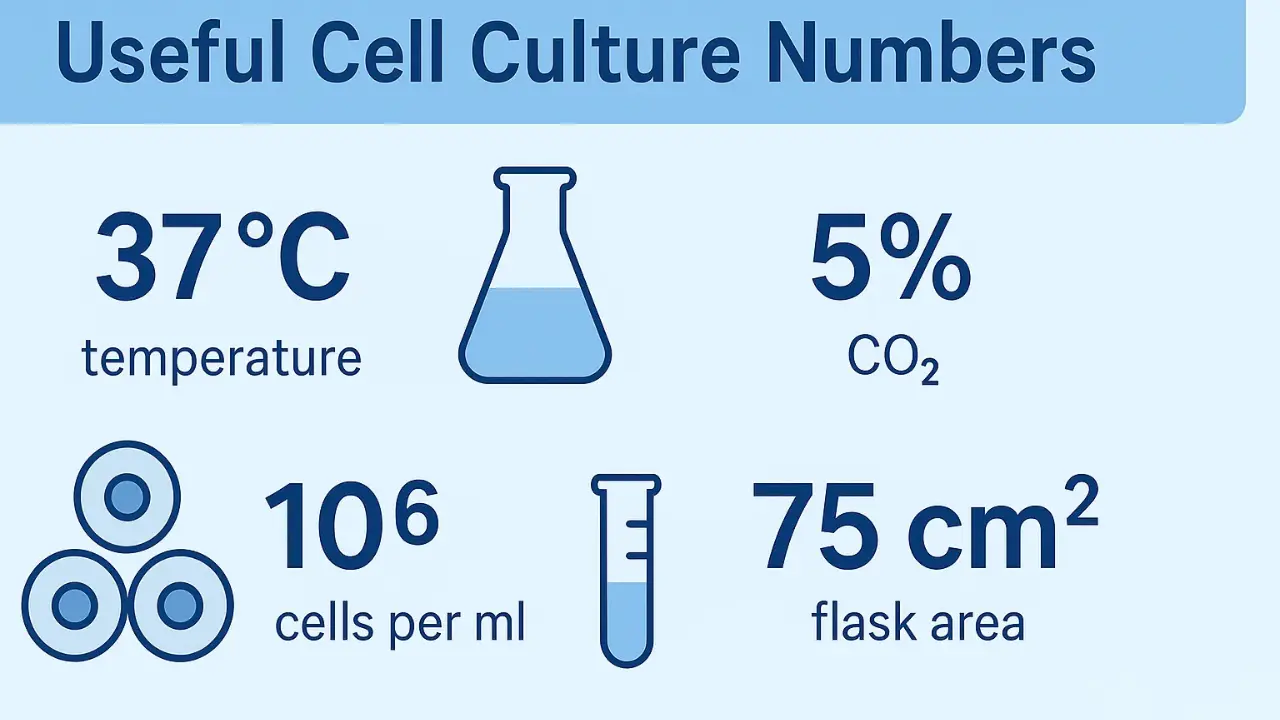
Temperature has a major influence on cell metabolism and growth. Many mammalian cell lines originate from organisms with body temperatures close to 37°C, so laboratories commonly maintain these cells near this temperature.
Temperature changes can affect enzyme activity, membrane function, protein production, and growth rates. Even cells that tolerate temporary temperature changes may behave differently when exposed to unsuitable conditions for long periods.
When reviewing useful numbers for cell culture, 37°C is therefore one of the most familiar values. It is not universal, however. Researchers must check the recommended temperature for each cell type before starting an experiment.
Jameliz Erome Age, Career, Income And Lifestyle
Carbon Dioxide and pH Levels
Many mammalian culture systems use bicarbonate-buffered media. In these systems, carbon dioxide in the incubator works with bicarbonate in the medium to help maintain an appropriate pH.
A 5% CO₂ atmosphere is common for many standard mammalian cultures, while a pH near 7.2 to 7.4 is frequently used. The exact relationship depends on the medium formulation and its bicarbonate concentration.
Phenol red is often included in culture media as a visual pH indicator. Changes in medium color can provide a quick warning that conditions have shifted, but color alone does not provide an exact pH measurement.
Cell Size and Cell Density
Cell size varies greatly between species and cell types. Many cultured mammalian cells fall within a broad range of approximately 10 to 30 micrometers, although some are smaller or much larger.
Cell density also matters because cells can behave differently at low and high densities. Researchers often describe adherent cultures by their percentage of confluence. A culture at 100% confluence has essentially covered the available growth surface.
Understanding useful numbers for cell culture helps when planning cell counts, plating experiments, and estimating growth. Exact seeding density should still come from the recommended protocol for the specific cell line and experiment.
Cell Confluence
Confluence describes how much of a culture surface is covered by adherent cells. For example, 50% confluence means cells occupy roughly half of the available surface.
Scientists use confluence as a practical indicator when observing cell growth. Waiting too long can cause some cell lines to become overcrowded, while manipulating a culture too early can leave too few cells for the planned experiment.
Different cell types tolerate confluence differently. Researchers should therefore avoid assuming that one percentage works for every cell line.
Common Cell Culture Vessel Sizes
Cell culture vessels come in several standard sizes. Flask names usually refer to the approximate surface area available for adherent cell growth.
A T25 flask provides about 25 cm² of growth area, while a T75 flask provides about 75 cm². A T175 flask offers about 175 cm² and can support a larger culture.
Multiwell plates provide another useful format. Laboratories commonly use 6-well, 12-well, 24-well, 48-well, and 96-well plates. Higher-density formats are also available for screening applications.
These useful numbers for cell culture make it easier to select a vessel that matches the scale and purpose of an experiment.
Approximate Working Volumes
Culture volume depends on the vessel, manufacturer, cell type, and laboratory protocol. A larger growth area normally requires a larger volume of medium to cover the surface properly and provide enough nutrients.
| Vessel | Approximate Common Working Volume |
|---|---|
| T25 flask | 5–7 mL |
| T75 flask | 10–15 mL |
| T175 flask | 25–35 mL |
| 6-well plate | 2–3 mL per well |
| 12-well plate | 1–2 mL per well |
| 24-well plate | 0.5–1 mL per well |
| 96-well plate | 100–200 µL per well |
These values are general estimates rather than fixed rules. Manufacturer recommendations should take priority because vessel geometry can differ between products.
Cell Counting and Hemocytometer Numbers
Cell counting allows researchers to estimate the concentration of cells in a suspension. A hemocytometer provides a chamber with a known grid and volume, making manual cell counting possible under a microscope.
A commonly used Neubauer-style chamber has a depth of 0.1 mm. The volume represented by a large 1 mm × 1 mm square is therefore 0.1 mm³, equal to 10⁻⁴ mL.
This relationship explains why a factor of 10⁴ appears in many hemocytometer calculations. Any dilution made before counting must also be included in the final calculation.
These useful numbers for cell culture are especially helpful when preparing cultures with a defined number of cells.
Centrifugation: RCF Versus RPM
Centrifugation is frequently used to collect suspended cells. Researchers should distinguish between revolutions per minute, or RPM, and relative centrifugal force, or RCF.
RPM only describes how fast the rotor spins. RCF describes the force experienced by the sample and depends on both rotor speed and rotor radius.
A commonly used relationship is:
RCF = 1.118 × 10⁻⁵ × r × RPM²
Here, r represents the rotational radius in centimeters. Reporting RCF is often more reproducible because two centrifuges can generate different forces at the same RPM.
Doubling Time and Cell Growth
Doubling time describes how long a cell population takes to double under particular conditions. Some rapidly growing mammalian cell lines may double in roughly 18–24 hours, while other cultures can require 30, 48, 72 hours, or longer.
Primary cells may grow more slowly than immortalized cell lines. Growth can also change with passage number, nutrient availability, seeding density, temperature, and cell health.
Researchers should measure or verify the doubling time of their own culture rather than relying entirely on a general value.
Freezing and Storage Temperatures
Long-term cell preservation commonly involves cryogenic storage. Laboratories often cool cells gradually before moving them into very low-temperature storage.
An ultra-low-temperature freezer may operate near −80°C, but long-term preservation of many mammalian cell lines is usually performed in liquid-nitrogen-based systems at much lower temperatures.
Liquid nitrogen has a boiling point close to −196°C at atmospheric pressure. Vapor-phase storage is warmer than liquid-phase storage but remains extremely cold.
Because cryogenic work involves serious safety hazards, laboratories must follow institutional procedures and use approved protective equipment.
Why Cell Culture Numbers Can Vary
No single table can provide perfect values for every culture system. Cell requirements depend on the species, tissue, cell line, medium, vessel, incubator, and purpose of the experiment.
For example, one cell line may grow well at a density that causes another line to stop dividing. Different media can also require different carbon dioxide conditions because their buffering systems vary.
For this reason, useful numbers for cell culture should serve as reference points rather than universal instructions. The supplier’s cell-line datasheet and validated laboratory protocol remain the most important sources for exact conditions.
Preventing Errors in Cell Culture Calculations
Small calculation mistakes can affect an entire experiment. Researchers should check units carefully when converting between milliliters and microliters or between cells per milliliter and total cell numbers.
Remember that 1 mL equals 1,000 µL, while 1 liter equals 1,000 mL. Clear labeling and written calculations can reduce avoidable errors.
Researchers should also record passage number, cell count, viability, medium type, culture date, and relevant incubation conditions. Consistent documentation makes experiments easier to reproduce.
| Measurement | Useful General Reference |
|---|---|
| Mammalian culture temperature | ~37°C |
| Common CO₂ concentration | ~5% |
| Common medium pH | ~7.2–7.4 |
| Incubator humidity | ~95% |
| 1 mL | 1,000 µL |
| 1 L | 1,000 mL |
| Hemocytometer chamber depth | 0.1 mm |
| Common counting factor | 10⁴ |
| Liquid nitrogen boiling point | ~−196°C |
| Ultra-low freezer | ~−80°C |
| Typical mammalian cell size | ~10–30 µm |
Frequently Asked Questions
What are the most important numbers to remember for cell culture?
For many mammalian cells, 37°C, approximately 5% CO₂, and a pH around 7.2–7.4 are common reference values. Exact requirements depend on the cell line and culture medium.
Why is 5% CO₂ commonly used?
Many culture media use a bicarbonate buffering system. Carbon dioxide interacts with this system and helps maintain the required pH under incubator conditions.
What does 80% confluence mean?
It means adherent cells cover approximately 80% of the available culture surface. Researchers often use confluence to monitor cell growth and determine experimental timing.
Is RPM the same as RCF?
No. RPM measures rotor speed, while RCF describes centrifugal force. RCF also considers the radius of the centrifuge rotor.
Conclusion
Learning useful numbers for cell culture gives researchers a practical foundation for understanding routine laboratory work. Values such as 37°C, 5% CO₂, pH 7.2–7.4, standard flask areas, common plate sizes, and basic volume conversions appear frequently in mammalian cell culture.
These figures are general reference values rather than fixed instructions. Reliable cell culture depends on following the requirements of the specific cell line, culture medium, equipment manufacturer, and validated laboratory protocol. Careful measurements, accurate calculations, sterile technique, and consistent record keeping help produce more dependable experimental results.